Mattress Materials · A Practical Guide
Dunlop Latex, Explained: What to Know About Natural Latex Sleep Surfaces
Resilient, responsive, and rooted in a natural material, Dunlop latex has a distinctive place in the world of mattresses. Understanding how it is made—and how it behaves beneath the body—can make it easier to judge whether this kind of sleep surface fits your preferences.
A mattress is an intimate piece of design: encountered in the quietest hours, expected to support the body without demanding attention. Its materials matter, but names on a label can only tell part of the story. “Natural latex” suggests a source; “Dunlop” describes a way of processing that material. Neither term, on its own, tells you exactly how a finished mattress will feel.
Dunlop latex is one of the established forms of latex used in natural latex sleep surfaces. It is made by transforming liquid latex into a resilient foam, then shaping and curing it into a solid layer. The result is often valued for its buoyant, springy response and substantial feel. Yet the overall experience depends on more than the latex process: firmness, layer arrangement, mattress cover, bed base, and a sleeper’s own body and habits all have a role.
For anyone exploring organic mattresses, Dunlop is best understood as one part of a broader construction. The useful question is not whether the material is universally superior, but how its properties align with the comfort, support, and material priorities you actually have.
What is Dunlop latex?
Latex used in bedding begins with latex, a milky fluid collected from rubber trees. The fluid is processed and formulated before it is poured into a mold, where it is aerated, heated, and cured into an elastic foam. In a Dunlop process, the prepared latex is placed into a mold and baked. After curing, the material is washed and dried, then formed into a finished layer suitable for use in a mattress.
That description is intentionally simple. Manufacturing details vary by producer, and the word “Dunlop” does not guarantee a single recipe, density, or firmness. Different formulations and production choices can yield latex layers with different characteristics. A finished mattress may also combine latex layers of different firmnesses, or pair latex with other materials in its comfort system and cover.
Latex is naturally elastic. When compressed, it tends to push back rather than slowly sink around the body in the same way some other foams do. This rebound is part of the familiar latex sensation: a sleeper may feel supported on the surface, with a noticeable ease of movement. The sensation is not identical across all latex beds, however. Thickness, firmness, quilting, and the support underneath it can make a significant difference.
From raw material to sleep surface
The appeal of Dunlop latex often begins with its material story, but a thoughtful evaluation follows that story all the way to the finished mattress. First, ask what the latex is made from. Products may contain natural latex, synthetic latex, or a blend. “Natural latex” refers to the source of the rubber content; it does not necessarily mean every part of the mattress is natural, organic, or free of other materials.
Next, look at how a manufacturer describes its sourcing and processing. Organic claims are most meaningful when they are accompanied by clear information about the scope of certification and the exact components covered. A certification may apply to latex, textiles, or other specified materials rather than to every element of the finished product. Read the product documentation carefully, and distinguish a certified ingredient from a certified complete mattress.
Finally, consider the construction as a whole. A latex layer may be enclosed in cotton fabric, quilted with wool, or combined with other materials. These components can affect surface feel, breathability, maintenance, and the way the bed responds. The mattress is not simply its foam core: it is a system of materials working together.
- Material source: Determine whether the latex is natural, synthetic, or blended.
- Certification scope: Check which materials and processes a stated certification covers.
- Complete construction: Review the cover, quilting, layer count, and any additional components.
- Care and service: Understand whether the cover is removable, how the mattress should be maintained, and what the warranty includes.
How does Dunlop latex feel?
Many sleepers describe latex as buoyant, responsive, or gently springy. Those words point to a surface that compresses under pressure and rebounds as pressure shifts. The feeling can make it easier to change positions than on a surface that holds a deep impression around the body. To some, that responsive quality feels lively and reassuring; to others, it may seem too firm or too active.
Dunlop latex is often associated with a denser, more substantial feel than other latex constructions, but that shorthand should not be treated as a rule. The specific formulation, density, firmness, and mattress design matter. A soft Dunlop layer can feel quite different from a firm one, and a multi-layer mattress can be configured to create a range of overall sensations.
Pressure relief also depends on the complete surface. A layer that is too firm for a particular sleeper may not yield enough at the shoulder or hip. A layer that is too soft may allow a sleeper to sink farther than they find comfortable. There is no firmness setting that can be inferred from the material name alone, and terms such as “medium” are not perfectly standardized across brands.
Temperature is similarly personal. Latex is commonly made with an open, aerated structure, and its feel may differ from denser foams that respond more slowly. But no material can guarantee that every sleeper will feel cool. Room conditions, bedding, sleepwear, body temperature, and the mattress cover all influence the microclimate of a bed.
Dunlop and Talalay: a useful comparison
Dunlop and Talalay are two methods used to produce latex foam. In broad terms, both begin with latex that is prepared and placed in a mold. The manufacturing steps differ, and the resulting materials can have different textures and performance characteristics. Talalay production includes additional steps, such as vacuum expansion and freezing before the material is cured. Dunlop production is generally more direct, with the latex placed in a mold and cured.
These differences can affect the character of a layer, but they do not create a simple ranking. It is tempting to reduce the comparison to “Dunlop is firm” and “Talalay is soft,” yet either type can be offered in a range of firmnesses. Brand formulation and the rest of the mattress construction can matter as much as the process name. Two beds made with the same type of latex may not feel alike.
When comparing options, treat the process as useful context rather than a verdict. Ask about the firmness of each layer, how layers are arranged, and whether the mattress allows configurations to be changed. If possible, try a comparable surface in person, while remembering that a brief showroom test cannot reproduce an entire night of sleep.
Choosing a latex mattress for your sleep style
Sleep position offers a starting point, not a prescription. Side sleepers often look for enough surface give around the shoulder and hip, while back sleepers may prioritize an even, supported feel through the torso and pelvis. Stomach sleepers commonly prefer a surface that does not allow excessive sinking through the midsection. These are broad considerations, not medical rules: body shape, weight, mobility, personal comfort, and existing conditions can all change what feels suitable.
Rather than selecting by position alone, notice what your body is telling you. Do you feel pressure at the shoulder or hip? Does your lower back feel comfortably supported? Can you turn without effort? Does the surface feel pleasant after several minutes, or does an initially appealing softness become less comfortable? These questions help translate a material description into a practical decision.
Couples may have different comfort needs, and a shared mattress does not always have to impose a single firmness choice. Some customizable designs offer separate configurations on each side in larger sizes. That can be useful when preferences differ, but it adds decisions: each sleeper must consider their own preferred feel, while the mattress’s middle and edge behavior remain part of the shared experience.
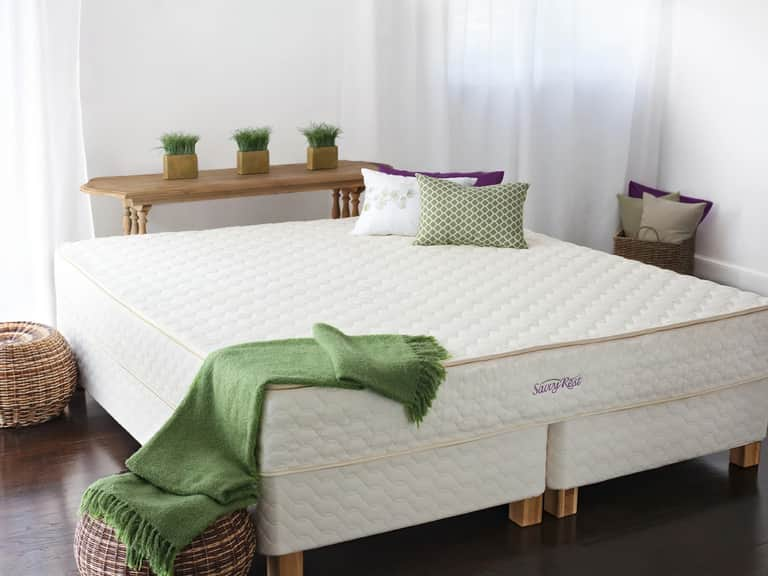
For example, the Savvy Rest Serenity Latex Mattress is a customizable 10-inch design with three layers of Dunlop and/or Talalay latex, available in soft, medium, or firm choices. Its organic cotton casing is quilted with wool, and Queen and King configurations can be customized by side. Those details make it an example of how latex type, layer selection, cover materials, and configuration come together in a complete mattress—not evidence that one particular arrangement is right for every sleeper.
Natural and organic: read the language carefully
“Natural” and “organic” are not interchangeable terms. Natural latex describes latex derived from rubber-tree sap, although a product may contain other materials as well. Organic claims refer to standards and certification, and the precise meaning depends on what has been certified. For a mattress, it is wise to check whether a claim applies to the latex itself, the cotton cover, wool batting, or the product as a whole.
Certification can help shoppers compare material claims, but it does not determine comfort, longevity, or suitability. A certified organic mattress can still feel too firm or too soft for an individual. Conversely, a material preference is only one part of a decision that also includes fit, support, construction, care, and budget.
Those with latex sensitivities should take particular care. Natural rubber latex can be a concern for people with a latex allergy. If you have a known or suspected allergy, consult a qualified health professional and contact the manufacturer for precise information about the materials and their location within the mattress. Do not rely on broad marketing language to assess an individual health risk.
Durability, upkeep, and practical considerations
Latex is valued for resilience, but durability cannot be promised by a material name alone. Construction quality, layer density, use, support from the bed frame, and care all contribute to how a mattress performs over time. Review the warranty for its actual terms, including coverage limits, required foundations, and what counts as a defect. A warranty is not a forecast of how long every mattress will remain comfortable.
Latex mattresses can be heavy, particularly when they contain several substantial layers. Moving, rotating, or assembling one may take more effort than handling a lighter mattress. A layered design with a zippered cover may make it possible to adjust or replace components, depending on the manufacturer’s policies, but the cover itself may not be machine washable. Always follow the care instructions for the specific product.
Support beneath the mattress matters, too. Check the manufacturer’s requirements for a compatible bed frame or foundation, including any limits on slat spacing. Some latex mattresses can be used on adjustable bases, but compatibility should be confirmed rather than assumed. A suitable foundation helps the mattress function as intended and may be required for warranty coverage.
Before ordering, make a practical checklist: confirm the mattress dimensions, delivery and setup arrangements, return or layer-exchange terms, warranty details, and whether old-mattress removal is available. For a customizable bed, ask how firmness choices are defined and whether the selected layers can later be changed. Clarity before purchase is more useful than discovering a policy after delivery.
Common assumptions worth questioning
- “Dunlop always feels firm.” The process does not dictate one firmness. Layer selection and the complete build shape the feel.
- “Natural means entirely chemical-free.” Manufacturing involves processing, and a mattress can include multiple materials. Look for specific, verifiable information rather than an absolute implication.
- “Organic means more comfortable.” Certification addresses defined material or process standards; comfort remains individual.
- “A mattress material solves back pain.” A mattress may affect comfort and support, but it is not a treatment or a substitute for medical advice. Persistent pain deserves guidance from a qualified professional.
- “One latex type is best for everyone.” Sleep preferences, body characteristics, construction, and budget vary. The right choice is the one that works for the person using it.
A considered way to compare options
Approach a mattress comparison as a small exercise in editing: remove the claims that cannot help you decide, then focus on the details that can. Begin with how you want the bed to feel—buoyant or gently cushioning, more yielding or more level. Consider your usual sleep positions and whether you share the bed. Then examine the product’s actual layer plan, not simply its headline material.
Next, investigate the evidence behind material and organic claims. Look for named certifications and their stated scope. Check the cover composition, the presence of wool or other quilting, and instructions for cleaning. Confirm that the base is compatible and that the return, exchange, and warranty policies suit your circumstances. If the mattress is customizable, ask how the layers affect the final feel and what options exist if your first configuration does not feel right.
Finally, give comfort the attention it deserves. A showroom visit can help you notice whether latex responsiveness appeals to you, but a few minutes on a display model is not conclusive. If you order, understand the trial or adjustment period and use it according to the seller’s terms. The aim is not to find the most impressive description. It is to find a thoughtfully made sleep surface that feels supportive and comfortable in your own room, night after night.
The takeaway
Dunlop latex is a resilient foam made by processing latex and curing it in a mold. Its responsive character is a defining feature, while its precise firmness and feel depend on formulation, layer design, cover materials, and the person sleeping on it. It can be an appealing option for people interested in natural latex sleep surfaces, including those comparing organic mattresses, but the label alone cannot promise comfort or suitability.
Look beyond the name. Compare certifications carefully, inspect the full construction, consider your preferred firmness and sleeping habits, and verify the practical details of care, support, and warranty. When those elements align, Dunlop latex becomes more than a material description: it becomes a considered choice in the making of a personal, restorative sleep space.